A car seat is the single most safety-critical purchase you will make for your child. This checklist evaluates certification, installation, harness fit, and crash performance — before price enters the conversation.
By Derrick Carvey, Founder, Carvey Innovations Limited · Originally published: January 1, 2025 · Updated: September 9, 2026
Use each evidence layer for its proper purpose, then check the exact seat in the actual vehicle.
This car seat safety checklist is built to help parents compare installation, harness fit, expiration, crash history, certification and NHTSA recall status before buying.
Transparency: This page contains affiliate links to Amazon. Recommendations are based on safety criteria and verified certifications — not commission rates.
A car seat is the only baby purchase where the wrong choice has direct, irreversible consequences. Choose based on criteria, not brand.
This checklist starts with certification and installation — the factors that determine whether a seat actually protects in a crash. Price and brand are evaluated after those criteria are met, not before.
The picks at the bottom are the ones that pass the full checklist. Start there before you compare anything else.
Your progress0 of 0 complete
Before the checklist
The type decision comes first — everything else follows
Car seats come in three categories: infant-only seats, convertible seats, and all-in-one seats. The right type is not determined by brand or price — it is determined by your child's current weight and height, your vehicle's LATCH system capacity, and how long you need the seat to last.
Infant seats are rear-facing only and have a lower weight limit — typically up to 30–35 lbs. Convertible seats grow with the child from rear-facing infant through forward-facing toddler. All-in-one seats extend further still into booster mode. Choosing the wrong type for your child's stage means replacing the seat sooner than necessary or — more critically — using a seat outside its tested safety range.
The quality-first principle
We identify the safety criteria first. Then we find which seats meet those criteria. Price is evaluated last — not first. A seat that fails the safety criteria is not a budget option. It is not an option.
Certifications to verify
Certification marks to verify for car seats
Certification marks on car seat listings represent compliance at a specific point in time. They do not guarantee the unit you receive is the unit that was tested. Counterfeit and grey-market car seats are a documented problem — particularly in online marketplace environments.
FMVSS 213
Federal Motor Vehicle Safety Standard 213
The mandatory US federal standard for child restraint systems. All car seats sold legally in the United States must comply. Covers crash performance, flammability, and labelling requirements. Look for the statement "This child restraint system conforms to all applicable Federal Motor Vehicle Safety Standards" on the seat label itself — not just the listing.
JPMA, now the Baby Safety Alliance, transitioned the legacy JPMA Certification Program to the current Baby Safety Alliance Verification Program. This voluntary layer is separate from FMVSS 213 and does not constitute federal approval or guarantee freedom from recalls, misuse, installation problems, or model-specific limitations. Company or category participation does not by itself establish exact-model verification.
Check the current program and exact scope through the Baby Safety Alliance; manual source review is required if the exact product listing is unavailable.
NHTSA Ease of Use
NHTSA Ease-of-Use Ratings
NHTSA independently evaluates car seats for how easy they are to install and use correctly. Misuse is the leading cause of car seat failure in a crash — not defect. A seat with a high ease-of-use rating is more likely to be installed and used correctly in real conditions. Check NHTSA's ratings before purchase.
The full evidence cards remain later in this checklist. These links simply let decision-ready readers inspect the same documented models now; verify exact model, vehicle fit, manual, current recalls and seller before purchase.
Britax One4LifeDocumented fit strengths with an important Consumer Reports test limitation disclosed in the full evidence card below.Inspect Britax →
Graco Extend2FitThe strongest-supported option of the three in the supplied evidence, with installation and transition trade-offs.Inspect Graco →
Safety 1st Guide 65Lower-cost documented option with meaningful rear-facing installation limitations described below.Inspect Safety 1st →
Affiliate disclosure: Amazon links may earn Verify Baby Guide a commission at no additional cost to you. Read the full evidence and limitations before treating any model as a fit for your child and vehicle.
Part 1 of 4 — Certification and compliance
Certification and compliance
Exact model number and manufacture date match the product, manual, and listing
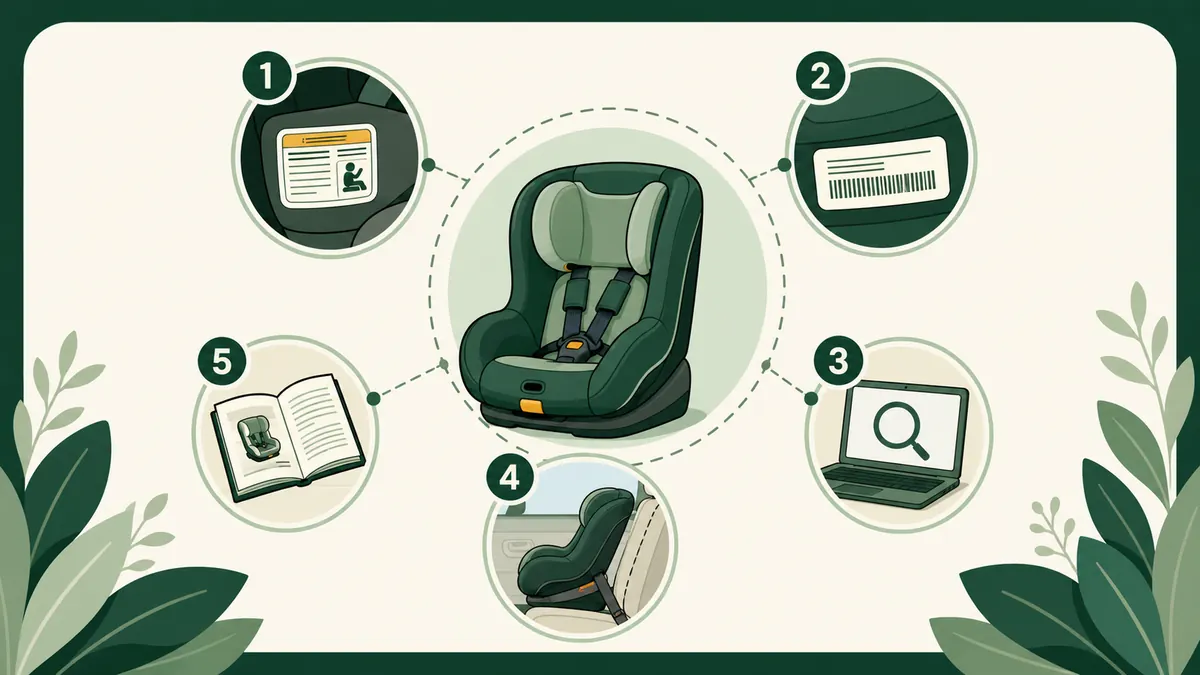
Read the permanent label on the seat itself. Do not rely on a family name or retailer title when checking limits, notices, verification status, or recalls.
Voluntary verification scope is confirmed for the exact model where applicable
The Baby Safety Alliance Verification Program is a voluntary evidence layer. Brand membership or a verified category is not proof that every model is individually verified.
The seat carries the FMVSS 213 compliance label on the seat itself — not only in the listing
Federal law requires this label to be permanently attached to the seat. A listing that claims compliance but where the received seat has no label is a serious red flag. Check the physical label on arrival before discarding packaging.
Manufacturer notices, current manual, and all required original or approved replacement parts are available
Review current corrective actions and instructions for the exact model. Do not use a seat with missing, improvised, or unapproved replacement parts.
Forward-facing tether use and the LATCH-to-seat-belt transition follow both manuals
Use the top tether for forward-facing harness installations as directed, and change installation method when the car-seat or vehicle lower-anchor limit requires it.
The seat has not been involved in a moderate or severe crash
Most manufacturers recommend replacing a car seat after any moderate or severe crash, even if no damage is visible. Internal structural integrity cannot be assessed visually. Never purchase a used car seat unless you can verify its full crash history.
The seat is within its expiration date
Car seats have expiration dates — typically 6 to 10 years from manufacture — because plastic degrades over time and safety standards evolve. The expiration date is printed on the seat itself. An expired seat should not be used regardless of its visual condition.
The seat is not subject to an active NHTSA recall
Car seat recalls are issued for defects that affect safety performance. Check the NHTSA recall database using the seat's model name and number before purchase and again after installation.
Part 2 of 4 — Fit for your child
Fit for your child
A certified seat that does not fit your child correctly provides significantly less protection than its test results suggest. Fit is not a secondary consideration — it is a safety requirement.
The child's weight is within the seat's rated rear-facing weight range
Rear-facing is the safest position for infants and toddlers. The AAP recommends keeping children rear-facing until they reach the maximum weight or height allowed by the seat manufacturer — not until a specific age. Verify the seat's rear-facing weight limit against your child's current weight.
The child's head is at least one inch below the top of the seat shell when rear-facing
When the top of the child's head is within one inch of the top of the seat shell, the child has outgrown the rear-facing position for that seat. This is a physical measurement — not an age or weight milestone.
The harness slots are at or below the child's shoulders when rear-facing
Harness straps must come from at or below the shoulders when the child is rear-facing. Straps above the shoulders in rear-facing mode reduce the harness's ability to manage crash forces correctly. Check this at each use as the child grows.
The harness passes the pinch test — no slack at the collarbone after tightening
After buckling and tightening the harness, pinch the strap at the child's collarbone. If you can pinch any webbing between your fingers, the harness is too loose. A properly tightened harness cannot be pinched. This test should be performed at every use.
Part 3 of 4 — Installation and vehicle fit
Installation and vehicle fit
NHTSA data consistently shows that misinstallation is a leading factor in car seat failure during crashes. A correctly certified seat, installed incorrectly, does not perform as tested. Installation must be verified — not assumed.
The seat is installed using either LATCH or seat belt — not both simultaneously
LATCH (Lower Anchors and Tethers for Children) and the seat belt are two separate installation methods. Using both simultaneously is not recommended and can actually compromise installation security. Choose one method and follow the manufacturer's instructions for that method.
For LATCH installation: the combined weight of child plus seat does not exceed the vehicle's LATCH weight limit
Most vehicles have a LATCH system weight limit of 65 lbs (child weight plus seat weight combined). Beyond this limit, the seat belt installation method must be used. Check your vehicle owner's manual for the specific LATCH weight limit — it varies by vehicle.
The installed seat moves less than one inch side-to-side and front-to-back at the belt path
After installation, grip the seat at the belt path and attempt to move it side-to-side and front-to-back. Movement of more than one inch in any direction indicates an insecure installation. Reinstall and retest before use.
The rear-facing seat recline angle is within the manufacturer's specified range
Rear-facing seats must be installed at the correct recline angle to keep the infant's airway open and to ensure the harness performs correctly in a crash. Most seats have a built-in recline indicator. Verify the bubble or indicator is within the specified range after installation.
Installation has been verified by a certified Child Passenger Safety Technician (CPST)
A CPST is trained specifically to verify car seat installation. NHTSA maintains a locator for certified technicians and inspection stations. Having installation verified by a CPST — especially for a first-time installation — is the single highest-value step most parents skip.
Part 4 of 4 — Day-to-day use and practical fit
Day-to-day use and practical fit
The chest clip is positioned at armpit level — not at the stomach or neck
The chest clip holds the harness straps in the correct position across the chest. Positioned too low — at the stomach — it can cause abdominal injury in a crash. Positioned too high — at the neck — it can cause airway injury. Armpit level is correct. Check this at every use.
No aftermarket accessories or padding have been added to the seat
Aftermarket head supports, strap covers, seat liners, and similar accessories are not crash-tested with the seat. Adding them can alter harness geometry, affect how the seat performs in a crash, and void the seat's certification. Use only accessories that came with the seat or are explicitly approved by the manufacturer.
The child is not wearing a thick coat or snowsuit in the harness
Bulky clothing compresses in a crash, creating slack in the harness that was not present when buckled. In a crash, this slack means the child moves further before the harness engages. Use thin layers and place a blanket over the harness after buckling if warmth is needed.
3 vetted picks
Exact-model evidence comparison
FMVSS 213 is the mandatory U.S. regulatory baseline. The Baby Safety Alliance Verification Program is a separate voluntary layer, and company/category participation is not proof of exact-model verification. Consumer Reports provides another, independent exact-model evidence layer. A score is a summary; the evidence underneath it is the buying decision.
Documented model
Britax One4Life ClickTight All-in-One
Documented model with excellent fit ratings and a material CR test limitation.
DOCUMENTED — MATERIAL TEST LIMITATION REQUIRES PROMINENT DISCLOSURE. Consumer Reports scored the Britax One4Life ClickTight 71, with 5/5 rear- and forward-facing fit-to-vehicle results and BETTER harnessed crash protection. CR also reported harness A-lock slippage or loosening in several simulated frontal crash tests under specified forward-facing configurations. CR did not present that finding as proof of regulatory noncompliance, and this page does not label the seat unsafe or imply a recall. The result is older evidence and the model is not in active CR testing.
Trade-off: Heavier than most alternatives at approximately 32 lbs. Not the right pick if frequent seat transfers between vehicles are needed. For a seat that stays in one vehicle and prioritises installation confidence above all else, this is the benchmark.
Best for: extended rear-facing at a mid-range price point with strong installation ratings
QUALIFIED STRONGEST-SUPPORTED OPTION OF THESE THREE. Consumer Reports scored the Graco Extend2Fit 73 and recommended it. CR reported 5/5 rear-facing fit-to-vehicle, 4/5 forward-facing fit-to-vehicle, BETTER harnessed crash protection, good small-car fit, a 50-lb rear-facing capacity, push-on LATCH connectors, and a no-rethread harness. Limitations included weight-dependent recline positions, a difficult LATCH transition, and a difficult-to-remove cover. Graco participates at the Baby Safety Alliance company/category level; exact-model status still requires database confirmation. The CR evidence is older and the model is not in active testing.
Trade-off: Does not extend to booster mode — this is a convertible seat, not an all-in-one. A separate booster will be required when the child outgrows the forward-facing weight limit.
Best for: a certified, compliant convertible seat at the most accessible price point
DOCUMENTED VALUE OPTION WITH MEANINGFUL INSTALLATION LIMITATIONS. Consumer Reports scored the Safety 1st Guide 65 67, with 3/5 rear-facing and 4/5 forward-facing fit-to-vehicle results and BETTER harnessed crash protection. CR documented rear-facing seat-belt installation difficulty, including tested positions where a rolled towel or locking clip was needed. Confirm installation in the actual vehicle before the return window closes and consider CPST help. Exact-model Baby Safety Alliance verification is not established by the supplied evidence. The CR evidence is older and the model is not in active testing.
Trade-off: The supplied evidence documents a lower rear-facing limit than the other two examples and material rear-facing installation difficulties. No booster mode.
Use each evidence layer for the question it can answer
Before buying or using a seat, check the FMVSS 213 label, exact model and manufacture date, current Baby Safety Alliance program scope where relevant, NHTSA recalls, manufacturer corrective actions, both manuals, and installation in the actual vehicle. Independent test results add model-specific context but do not replace compliance or correct installation.
This is our standard across every checklist on Verify Baby Guide. The purchase is not complete until the certification is verified.
Use NHTSA car-seat guidance and recall tools, the current Baby Safety Alliance Verification Program database, manufacturer manuals and corrective-action notices, and the applicable Consumer Reports exact-model page. Exact Baby Safety Alliance and CR URLs require manual sourcing because they were not supplied in the repository evidence package.