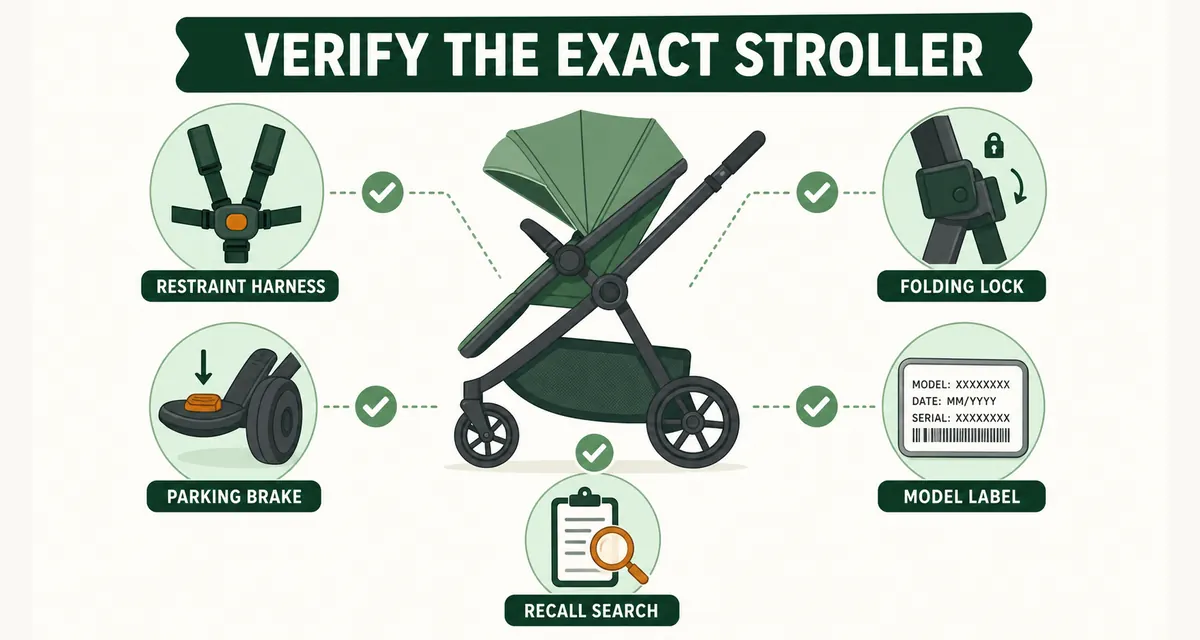
Use this verification checklist to examine a specific stroller's restraints, brakes, folding mechanisms, approved configurations, model information and recall status before buying or keeping it.
By Derrick Carvey, Founder, Carvey Innovations Limited
Updated: September 9, 2026
📋 15-point checklist🛒 3 model examples⏱ 7 min
This baby stroller safety checklist is built to help parents compare harness design, brakes, fold safety, weight, terrain fit, canopy, storage and CPSC recall status before buying.
Transparency: This page contains affiliate links to Amazon. Recommendations are based on safety criteria and verified certifications — not commission rates.
Verify the safety-critical details and the daily fit.
Weight and fold design can strongly affect daily usability, while approved configurations, restraints, brakes, loading limits and recall status require model-specific verification. This checklist gives you a repeatable way to check both.
Your progress0 of 0 complete
Before the checklist
Start with the way the stroller will actually be used
The stroller market is enormous and heavily marketed. Cup holders, snack trays, and colour-matched accessories are the details that get photographed. What gets underweighted in most buying decisions is the experience of folding a stroller with one hand while holding a baby, loading it into a car boot, or navigating a narrow shop aisle.
Weight and fold design may become decisive when a caregiver must lift the stroller, use stairs or public transport, or fit it into a small vehicle. Compare published dimensions with the real storage space and try the fold under realistic conditions when possible.
Start with your context, not the product
Answer these before looking at any specific stroller: How often will you use public transport? Do you have a car boot with limited space? Do you need a newborn-compatible stroller, or can you start with a car seat and add a stroller at 6 months?
From use case to model inspection
Already know how the stroller must fit your routine?
The full checklist and model-level verification notes remain below. These links let decision-ready readers inspect the same three examples without skipping the need to verify limits, configurations, recalls and seller information.
UPPAbaby VISTA V3Investigate when multi-child configurations and an approved bassinet are important.Inspect VISTA V3 →
Baby Jogger City Mini GT2Investigate when mixed surfaces and compact folding matter; “all-terrain” does not imply jogging approval.Inspect City Mini GT2 →
Graco Modes PrametteInvestigate when an infant-car-seat bundle and multiple approved stroller modes fit the routine.Inspect Modes Pramette →
Affiliate disclosure: Amazon links may earn Verify Baby Guide a commission at no additional cost to you. The later evidence cards explain the model-specific checks and limitations.
Part 1 of 3 — Safety and structure
Safety and structure
U.S. model is identified as compliant with the applicable carriage and stroller requirements
The U.S. mandatory standard is codified at 16 CFR Part 1227. It incorporates ASTM F833 with the version and any modifications accepted by the CPSC; ASTM is not the federal regulator. Confirm model and manufacturer information and review the CPSC carriage and stroller guidance.
Harness adjusts securely for the child in the intended configuration
Confirm the shoulder, waist and crotch restraints are present, undamaged, positioned correctly and adjusted exactly as the stroller manufacturer directs. Do not substitute a universal finger-spacing rule for the model's instructions.
Parking brake securely holds the stroller when engaged
Operate and check the parking brake according to the manufacturer instructions. Confirm it engages fully and holds the stroller before placing or removing a child.
Loading follows the manufacturer's stability instructions
Do not conduct an improvised tip test with a child seated. Do not hang bags or loads from the handle unless the manufacturer expressly permits it; use designated storage and stay within every stated loading limit.
Canopy coverage and use fit your climate and routine
Check the manufacturer's canopy materials and use instructions, then plan additional weather-appropriate protection where needed. A canopy claim does not replace supervision or safe-use instructions.
Part 2 of 3 — Usability and daily handling
Usability and daily handling
Fold can be completed reliably under your realistic use conditions
Test the fold and unfold process according to the manufacturer's instructions under realistic conditions. Consider where the stroller will be folded, how often it will be handled, and whether the caregiver will routinely be supervising or holding the child while managing the stroller.
Folded dimensions fit in your specific car boot
Measure your car boot before purchase. Do not rely on listed dimensions alone — confirm the stroller fits in the folded orientation you will actually use, including whether wheels face up or down.
Weight is manageable for the person who will use it most
Consider who will be lifting the stroller into a car boot, up stairs, or onto public transport. A stroller that requires significant upper body strength to lift becomes a problem in practice.
Handlebar height is appropriate for your height without bending or stretching
An uncomfortable handlebar height can make repeated pushing and maneuvering less comfortable, especially during extended use. Adjustable handlebars accommodate a wider range of users — confirm the adjustment range covers your height.
The intended newborn configuration is explicitly approved by the manufacturer
A deep or near-flat recline alone does not establish newborn suitability. Confirm the model's age and weight limits and use only an approved bassinet, a compatible infant car seat installed as directed, or a stroller seat the manufacturer explicitly approves from birth.
Part 3 of 3 — Longevity and value
Longevity and value
Weight limit is appropriate for the full intended age range
Confirm the stated weight limit covers the age range you plan to use the stroller for. Some lightweight strollers have weight limits that are reached before the child is ready to walk independently.
Replacement parts (tyres, wheels, fabrics) are available from the manufacturer
A stroller used for 2–3 years will experience wear. Confirm replacement tyres and seat fabrics are available and priced reasonably before committing.
Car seat compatibility is confirmed if purchasing as a travel system
If purchasing a stroller to use with a specific car seat as a travel system, confirm compatibility using the manufacturer's published compatibility guide — not the retailer's compatibility claim.
Warranty, support and replacement-part terms are acceptable
Review the warranty duration, exclusions, claim procedure, manufacturer support and the availability and cost of replacement parts. A longer warranty may signal value, but it is not a safety requirement.
Exact model information and recall status can be verified
Confirm the manufacturer, model number and manufacture date on the stroller, then search the CPSC recall database and the manufacturer's current safety notices for that exact product.
Models to verify
Verify safety-critical features and identity on the exact stroller; always follow the manufacturer’s instructions and check current recall records.
Three examples, with claims checked at the model level
Convertible system
UPPAbaby VISTA V3
Investigate if: multi-child configurations and an approved bassinet matter
The official VISTA V3 manual identifies a 50 lb maximum for the toddler seat and provides configuration-specific instructions. UPPAbaby also documents GREENGUARD certification for the VISTA V3 and Bassinet V3. Confirm what is included in the exact package, permitted configurations, current warranty and model identifier before buying.
Verification note: An older 2015 VISTA recall does not establish the status of a VISTA V3. Search the exact model and manufacture information in the CPSC database.
Investigate if: mixed surfaces and a compact fold matter
Baby Jogger's current product page lists a stroller weight of 22.4 lb and provides a current stroller and infant-car-seat compatibility guide. Verify the exact seat limits, approved newborn configuration, adapter, wheel-use restrictions and warranty in the current manual. VerifyBabyGuide has not physically tested this model.
Verification note: “All-terrain” does not mean approved for jogging. Use only for activities the manufacturer expressly permits.
Investigate if: an infant-car-seat bundle and multiple modes fit your routine
Package contents and specifications can vary by model number and retailer bundle. Confirm the included infant car seat, approved stroller configurations, child limits, folded dimensions and warranty against the current Graco manual for the exact model. Do not infer newborn suitability from a recline description alone.
Verification note: Historical Graco stroller recalls involved other named models. Recall searches must use the exact model number and manufacture information.
Check stroller harness, brakes, fold safety, weight, terrain fit, canopy, storage and CPSC recall status before buying.
How should parents use the Baby Stroller Checklist?
Use the checklist before comparing products, keep notes on model-specific details, and verify safety claims against official certification or recall sources where available.