Infant vs Convertible Car Seat: What's the Difference, What's Safer, and When to Switch
An infant car seat is rear-facing only and designed for newborn portability. A convertible car seat stays in the car, starts rear-facing for infants, and later turns forward-facing for toddlers.
Neither type is inherently safer. The safer choice is the one that fits your baby's current size, fits your vehicle correctly, and is used properly every time. This guide explains the difference, when to switch, and which type makes more sense for your situation.
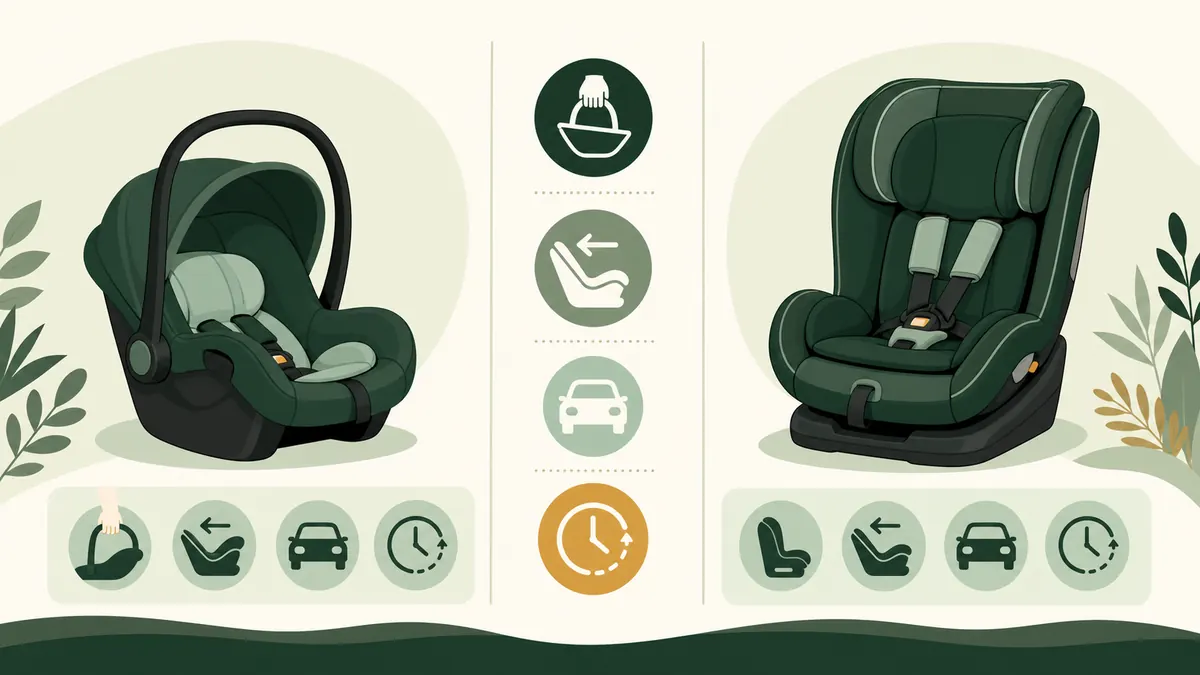
What Is a Convertible Car Seat, and How Is It Different From an Infant Seat?
An infant car seat is rear-facing only and usually combines a removable carrier with a base. A convertible car seat stays in the vehicle, begins rear-facing, and later changes to forward-facing when the child and exact model meet the manufacturer’s requirements.
Either type may be suitable from birth, but a convertible must explicitly permit newborn use and provide correct harness, recline and body fit for that child. There is no universal winner: an infant seat favors portability, while a convertible can provide a longer use window.
Seat type alone does not prove a safety advantage. Compare the child’s fit, the vehicle and seating position, installation feasibility, exact-model instructions, recalls and relevant model evidence. The better choice is the one caregivers can install and use correctly every trip.
Infant vs convertible car seat: what each means
Both must meet FMVSS 213. The right choice depends on your baby's size and your lifestyle.
Verify Baby Guide · Independent safety-first buying guide · Full car seat checklist →
What actually separates these two seat types
An infant car seat is rear-facing only. It has a base that stays in the car and a carrier that clicks in and out, so you can move a sleeping baby from car to stroller to home without disturbing them. The trade-off is a shorter lifespan — most infant seats are outgrown by weight or height between 9 and 18 months.
A convertible seat stays in the car. It starts rear-facing for infants and transitions forward-facing for toddlers. No carrier, no clicking in and out — what you gain in longevity you lose in portability. Many families use an infant seat for the first year and then move to a convertible, while others skip the infant seat entirely and start with a convertible from birth.
Neither approach is a universal winner. The choice depends on newborn fit, vehicle fit, installation, portability needs and how caregivers actually move through the day.
Can a convertible car seat be used for a newborn?
Yes, but only when the exact convertible model permits use from birth and the newborn meets every minimum fit requirement. Confirm that the harness can sit at or below the shoulders, the crotch buckle and approved inserts support the required fit, and the seat reaches the permitted rear-facing recline in the actual vehicle. A separate insert does not make an otherwise unsuitable seat newborn-ready; use only parts approved by the manufacturer. Test the fit before the return window closes.
Convertible vs all-in-one car seat
A convertible changes from rear-facing to forward-facing. An all-in-one adds a booster mode. The extra mode may reduce future purchases, but it can also make the seat larger or heavier, and it does not guarantee ideal fit in every mode. Compare the exact limits, vehicle fit and usability rather than choosing by lifespan claim alone.
Seat type by age, weight, and key features
These tables cover the criteria that matter at the point of purchase — seat type, weight range, certification, and the features that affect daily safety and usability.
Table 1: Seat type overview
| Seat Type | Age Range | Weight Range | Facing Direction | Best For |
|---|---|---|---|---|
| Infant | Birth to ~12–18 months | 4 to 22–35 lbs (varies by model) | Rear-facing only | Portability, early months |
| Convertible | Birth to ~4–8 years | 5 to 40–65 lbs rear-facing; up to 80–120 lbs forward-facing | Rear then forward | Long-term use, single seat |
| All-in-One | Birth through booster age | Up to 100–120 lbs | Rear, forward, booster | Maximum lifespan, no transitions |
Table 2: Safety certification requirements
| Certification | What It Covers | Required? | Applies To |
|---|---|---|---|
| FMVSS 213 | Federal crash safety standard. Frontal and rear impact testing. | Yes — mandatory | All car seats sold in the US |
| Voluntary verification | Independent verification of federal standards plus additional safety checks. | Voluntary | Products listed within the current Baby Safety Alliance Verification Program scope |
| Side Impact | Tests for protection in side collisions. No federal standard exists for this. | No standard | Brand-specific testing only |
| LATCH System | Lower Anchors and Tethers for Children. Standardised installation method. | Required on all seats | All car seats sold in the US |
Table 3: Practical comparison for daily use
| Feature | Infant Seat | Convertible Seat |
|---|---|---|
| Portability | High — carrier clicks in and out | None — stays in vehicle |
| Stroller compatibility | Yes — most click onto travel system strollers | No |
| Newborn fit | Designed for newborns — includes inserts | Varies — check minimum weight and newborn insert availability |
| Lifespan | 12 to 18 months typical | 4 to 8 years typical |
| Total cost | Higher — need to add convertible seat later | Lower long-term — one seat covers multiple stages |
| Installation frequency | Base stays in car, carrier lifts out | Installed once and stays |
| Weight of seat | Lighter carrier — easier to carry | Heavier — not designed to be carried |
Which option fits your situation?
Choose an infant seat when carrying the baby outside the vehicle, travel-system compatibility or moving one carrier among approved bases is central to your routine. Plan for a later convertible purchase.
Choose a convertible from birth when the exact model fits the newborn and vehicle, the seat can remain installed, and longer rear-facing use matters more than portability.
Switch from an infant seat when any exact manufacturer height, weight or fit limit is reached—not at a birthday. Continue rear-facing in the convertible until its rear-facing limit is reached.
Use the full car-seat buying guide, the focused installation guide, and the car-seat checklist to verify a specific model.
Know which seat type fits your routine?
These two documented examples let you inspect the market without changing the safety decision above. Confirm child fit, vehicle fit, current manual, exact model, recalls and seller before ordering.
Affiliate disclosure: Amazon links may earn Verify Baby Guide a commission at no additional cost to you. The full model-level evidence and trade-offs remain below.
What applies to every car seat, every time
These rules apply regardless of seat type or brand. They are the factors that most commonly contribute to car seat misuse — and misuse is far more common than most parents realise.
Certified Child Passenger Safety Technicians (CPSTs) offer free car seat checks at fire stations, hospitals, and community events across the US. You can find your nearest inspection station at the NHTSA website. Having your installation checked by a technician is one of the highest-value safety steps available to parents — and it costs nothing.
One infant seat and one convertible, chosen by safety criteria
Both picks are selected by applying the criteria in our Car Seat Safety Checklist. If you're still deciding between an infant vs convertible car seat, start with the 5 rules in this guide and then use the checklist to compare specific models. Certification status is independently verified.
Seat type does not replace exact-model evidence
Choosing infant versus convertible is the category decision. A convertible seat may be appropriate from birth only when the exact model permits newborn use and the child meets its minimum fit requirements; a newborn insert is not universally required.
For either type, examine exact child and vehicle fit, the allowed installation method, FMVSS 213 baseline, current voluntary-verification scope where applicable, exact-model independent testing, recalls or corrective actions, evidence age, and material limitations. Then use the installation guide and car-seat checklist.
Three verification steps once you decide
Check your vehicle's manual for weight limits on the LATCH anchors before assuming you can use LATCH. Many vehicles have LATCH weight limits of 40 to 65 lbs combined — meaning the seat plus the child — and this is lower than most parents expect. Above that limit, the seat belt is often the correct installation method.
Confirm the seat's expiration date before purchasing second-hand or using a stored seat. Most car seats expire 6 to 10 years from the manufacture date, which is molded into the plastic. An expired seat may have compromised structural integrity that is not visible externally.
Once your seat arrives, verify what you received using our Product Verification Checklist before installation — including manufacture date, certification labels, and that all components are present and undamaged.
Infant and convertible car-seat questions
What is the difference between an infant and convertible car seat?
An infant seat is rear-facing only and usually has a removable carrier. A convertible seat stays installed and can be used rear-facing, then forward-facing when the exact model and child meet the manufacturer requirements.
When should I switch from an infant to a convertible car seat?
Switch when the child reaches the infant seat's exact height or weight limit, or when another manufacturer-stated fit limit is reached. Use the labels and manual for the exact model rather than a general age.
Can a convertible car seat be used for a newborn?
A convertible seat may be used from birth only when the exact model permits newborn use and the child meets the manufacturer's minimum fit requirements. An insert alone does not establish newborn suitability.
Is an infant car seat safer than a convertible?
Seat type alone does not establish a universal safety advantage. Compare exact child fit, vehicle fit, installation feasibility, model-specific evidence, recalls, and manufacturer instructions.
What age is a convertible car seat for?
Convertible-seat use depends on the exact model's minimum and maximum fit requirements rather than one universal age range. Follow the manufacturer limits for rear-facing and forward-facing use.