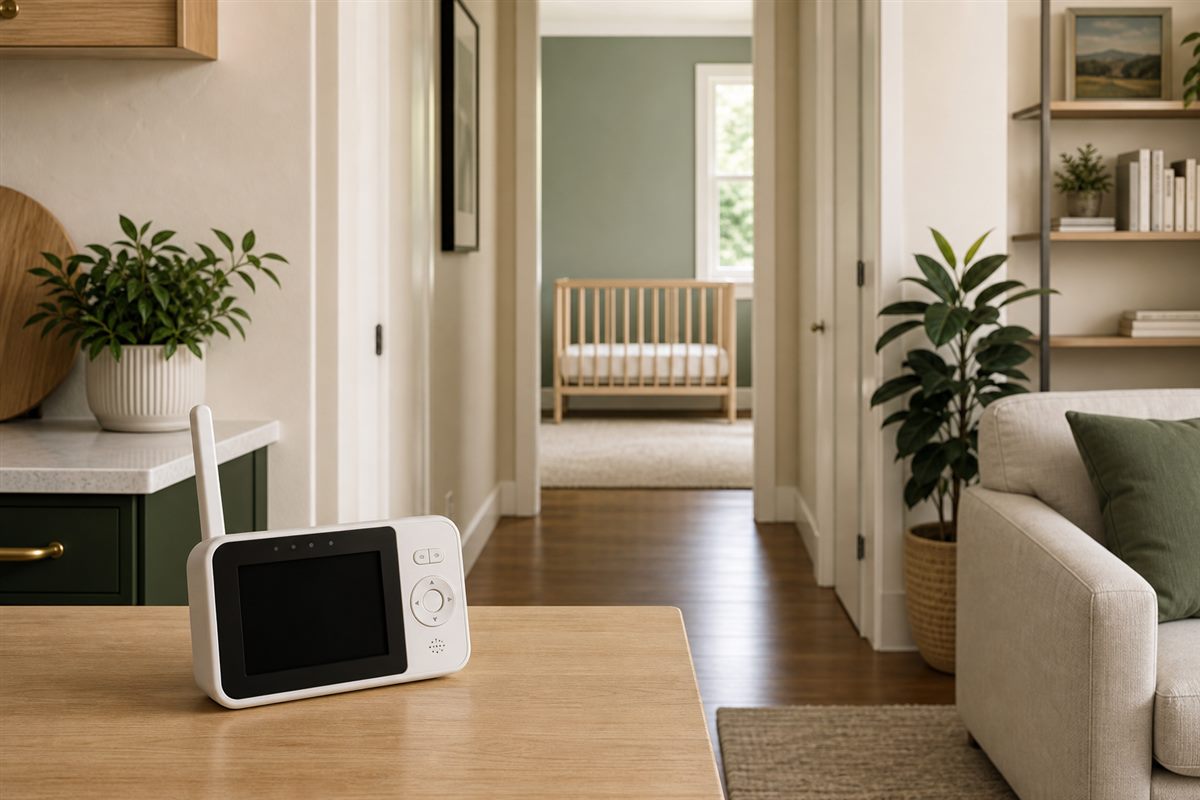
The better question is not "which monitor?" It is "what would this monitor do for me?"
A baby monitor is not a magic safety device. It does not make sleep safer, prevent SIDS, or replace safe-sleep basics. What it can do is simple: help you hear or see your baby when you are somewhere else.
That sounds obvious, but it changes the buying decision. If you can already hear your baby from the places where you normally sit, cook, shower, or sleep, a monitor may not add much. If the nursery is upstairs, down a hallway, behind thick doors, or far from your living space, then yes, a monitor can make daily life calmer.
Buy a monitor for distance, layout, and practical awareness. Do not buy one because every registry list says it belongs there.
A monitor helps when your home creates real blind spots.
You are a good candidate for a monitor if your baby sleeps where ordinary sound does not travel well. That might mean a nursery on another floor, a larger house, a noisy air conditioner, a closed-door nap routine, or a parent who needs to step into the yard, laundry room, garage, or home office while the baby sleeps.
In those cases, a monitor saves you from guessing. It can also reduce unnecessary room checks. If opening the nursery door keeps waking the baby, a basic monitor may be the quiet little helper you actually need.
You would otherwise need to keep walking back to the nursery just to know whether your baby is asleep, fussing, or fully awake.
Small homes and room-sharing often make a monitor optional.
If your baby sleeps in your room, especially in the early months, you may not need a separate device at all. The American Academy of Pediatrics explains that babies should sleep in the same room as parents, on a separate sleep surface, for at least the first 6 months. In that setup, you are already close enough to hear normal waking sounds.
The same can be true in a small apartment or compact home. If you can hear the crib from the kitchen, bedroom, and living room, a monitor may mostly give you duplicate information. That is not dangerous, but it may be unnecessary.
Your baby is room-sharing, your home is small, or you already hear normal cries clearly without opening an app or carrying a receiver.
Some parents feel calmer with a monitor. Some feel worse.
This part is personal, and it matters. A monitor can be reassuring if you hear a noise and want to check whether your baby has settled. But for some parents, especially with video or smart monitors, the feed becomes something they keep checking even when nothing is wrong.
If you know that live video or constant alerts will pull you into watch mode, choose the simplest monitor that solves the real problem. That may be audio-only. It may be a non-Wi-Fi monitor. It may also be no monitor until your baby moves to a separate room.
The AAP also cautions parents not to use home cardiorespiratory monitors as a way to reduce SIDS risk. If your baby has a medical condition, follow your clinician's guidance. For a healthy baby, safe sleep practices matter more than monitoring data.
Start simple, then add features only if they solve your actual problem.
If you only need to know whether the baby is awake, audio may be enough. If you want to see whether they are stuck in a corner of the crib, video may help. If grandparents or a parent away from home need remote viewing, Wi-Fi may be useful, but it brings account security and app-dependence with it.
Once you decide you actually need a monitor, the next choice is whether a WiFi or non-WiFi model best fits your home. WiFi adds remote access but also ongoing security responsibilities. Review whether WiFi baby monitors are safe, then compare the practical trade-offs in the WiFi vs non-WiFi baby monitor guide.
Before choosing a model, use the Baby Monitor Checklist. It walks through range, privacy, battery life, night vision, mounting, and security so you are not buying by feature count alone.
Choose WiFi when remote viewing is genuinely useful for your home and routine. A non-WiFi monitor is often simpler and has fewer security concerns because it does not connect through the internet. Choose based on where you need to monitor from, how your home is arranged, and whether you are willing to manage ongoing account and device security.
If a monitor makes sense for your home, turn that decision into a practical shopping plan based on your budget and priorities.
Build My Baby Monitor Plan →The checklist keeps the decision grounded in your home, not in a product listing.
Open the Baby Monitor Checklist →References: American Academy of Pediatrics / HealthyChildren.org safe sleep guidance; CDC safe sleep guidance; AAP guidance that home cardiorespiratory monitors should not be used as a SIDS-reduction strategy for healthy infants.
Helpful sources: AAP safe sleep guidance, CDC safe sleep summary, and AAP home apnea monitor guidance.