Safety guide · EMF and security

Are Baby Monitors Safe? Wi-Fi Risks, EMF Distance, and What Actually Matters

Baby monitors can be used safely, but the real issues are not all the same. Wi-Fi monitors create security and privacy risks that parents need to manage actively, while EMF concerns are better handled with distance and placement rather than panic.

This guide separates those risks clearly, explains what the evidence actually shows, and helps you decide whether a Wi-Fi or non-Wi-Fi monitor makes more sense for your home.

🔬 Research-based 📡 EMF + security ⏱ 7 min
Quick answer

Yes, baby monitors can be used safely. The more important question is what kind of risk you are trying to reduce: Wi-Fi monitors raise real security and privacy issues, while EMF concerns are better handled through distance and placement.

Safety guide · 2026

Are baby monitors safe? Two questions, two separate answers

EMF exposure and security risk are different concerns requiring different frameworks. Here is what the evidence shows on each.

Question 1
EMF exposure from the signal
Uncertain — precautionary approach warranted
No conclusive evidence of harm at typical household exposure levels
WHO classifies RF-EMF as "possibly carcinogenic" — not confirmed harmful
Distance is the key variable — exposure drops sharply beyond 3 feet
Precautionary approach: position monitor at least 3 feet from sleep surface
Question 2
Security and privacy vulnerabilities
Documented — active and underreported
Security researchers found critical flaws in multiple popular Wi-Fi models
8 of 9 consumer monitors rated a security grade of F
Higher price did not correlate with better security
Unauthorised access incidents have been publicly documented
Wi-Fi vs DECT monitor — risk profile side by side
Wi-Fi monitor
Internet connection
Yes — app and cloud server required
Remote access risk
Real — documented unauthorised access
Remote viewing
Yes — from anywhere
Security burden
Ongoing — password, firmware, 2FA
EMF level
Similar to DECT — manage with distance
DECT / non-Wi-Fi monitor
Internet connection
None — closed radio signal
Remote access risk
None — no known remote hacking pathway
Remote viewing
No — in-range only
Security burden
None required after setup
EMF level
Similar to Wi-Fi — manage with distance
Specific Wi-Fi vulnerabilities that matter
Default passwords that ship with devices and are rarely changed
Unencrypted RTSP video streams accessible to anyone with the device IP
UPnP settings that automatically open router ports to external access
Cloud storage with privacy policies permitting unrelated data use
Practical steps — by monitor type
If using a Wi-Fi monitor
1
Change the default password immediately on setup
2
Enable two-factor authentication
3
Keep firmware updated — check monthly
4
Position at least 3 feet from sleep surface
5
Buy from brand-authorised retailers only
If using a DECT monitor
1
Position at least 3 feet from sleep surface
2
Do not use as a substitute for safe sleep practices
3
Confirm range covers your home before relying on it
4
No ongoing security management required
The measured position
EMF risk: uncertain but manageable with distance. Security risk: real, documented, and your responsibility to manage actively. Neither concern requires avoiding monitors entirely — both require informed choices about type and positioning.

Verify Baby Guide · Independent safety-first guide · Baby Monitor Checklist →

There are two separate baby monitor safety questions

When parents ask whether baby monitors are safe, they are usually asking one of two different questions: whether the signal itself is a health concern, or whether the monitor creates a security and privacy problem inside the home. Those are different risks, and they need different answers.

This guide separates them clearly — covering what the current evidence shows on each, where the genuine uncertainty lies, and what the practical implications are for a parent making a purchase decision.

What EMF concerns actually mean for baby monitors

Baby monitors emit non-ionising radiofrequency energy, the same broad category as Wi-Fi routers, phones, and other wireless household devices. Unlike ionising radiation, it does not have enough energy to directly damage DNA, which is why regulators generally consider normal household exposure low risk.

The area of ongoing research is whether prolonged low-level EMF exposure has cumulative biological effects — particularly for developing infants, whose skulls are thinner and whose brains are still forming. A 2025 peer-reviewed study published in a medical journal followed 105 infants over one year, measuring EMF exposure using medical-grade equipment. In homes with the highest measured EMF levels, infants showed statistically elevated rates of fine motor delays and problem-solving difficulties. The authors identified household devices — not cell towers — as the primary EMF source in affected homes.

This is a single study. It cannot establish causation. And it sits within a broader scientific literature that has not produced consensus on whether household EMF levels cause developmental harm. But the study's methodology was rigorous, and its findings warrant acknowledgment rather than dismissal.

The precautionary approach

If EMF proximity is a concern, the most effective practical response is distance. A monitor placed across the room exposes an infant to a fraction of the EMF of one placed directly against the crib. This costs nothing and requires no product substitution. Most guidelines recommend placing any wireless device — monitor, router, or otherwise — at least 3 feet from the infant's sleep surface.

Before you decide on a monitor, use the checklist to evaluate any model against the criteria that actually matter — signal reliability, security, and real-world performance in your home.

Use the Baby Monitor Checklist before you decide →

Wi-Fi monitor security risks are real and easier to underestimate than EMF

The security risk from Wi-Fi baby monitors is not theoretical. In 2024, security researchers from Bitdefender described exploiting IoT baby monitor vulnerabilities as "child's play" — finding critical flaws in multiple popular smart monitor models. One research team discovered that certain monitors were regularly transmitting data to a server in Beijing that had no documented relationship with the manufacturer. Belgian and Portuguese consumer groups conducting independent testing found similar vulnerabilities across brands marketed to safety-conscious parents.

The human consequences have been documented. A mother in 2023 discovered her Owlet camera had been accessed by an unauthorised party — her young son had begun refusing to have the camera in his room because, as he told her, "someone talks to me at night." When she investigated, she found her password had been compromised in a data breach the manufacturer had never disclosed to her. In October 2025, a Colorado mother heard a stranger's voice through her Wi-Fi monitor mid-evening and immediately unplugged the device.

A cybersecurity firm's evaluation of nine consumer-grade Wi-Fi baby monitors assigned eight of them a security grade of F and one a grade of D. Higher price did not correlate with better security — in fact, pricier models with more features often had more exploitable entry points.

The vulnerabilities that matter most

Default passwords that are never changed.

Unencrypted video streams accessible through the device IP.

Router settings that open external access automatically.

Outdated firmware with known security holes.

Cloud storage and app permissions the parent does not fully control.

DECT and FHSS monitors remove the internet risk, not every risk

A DECT (Digital Enhanced Cordless Telecommunications) or FHSS (Frequency-Hopping Spread Spectrum) monitor does not connect to the internet. There is no app, no cloud server, no manufacturer account, and no pathway for remote access by an unauthorised party. The signal is a closed, encrypted radio transmission between two units in the home. The security risk profile is fundamentally different from a Wi-Fi device. For a detailed breakdown of how these two types compare across safety, features, and use cases, see the WiFi versus non WiFi baby monitor comparison.

DECT monitors do emit EMF — they are radio-frequency devices. However, the practical EMF management approach is the same: distance from the infant's sleep surface reduces exposure significantly. At 6 feet, EMF exposure from a DECT monitor is substantially lower than at 1 foot. This is a positioning decision, not a product substitution.

A 2024 systematic review of baby sleep monitoring research in Health and Social Care in the Community noted that research specifically on non-Wi-Fi DECT monitors in home environments is limited, and that most safety literature focuses on Wi-Fi-connected devices. The absence of documented security incidents with DECT monitors is a meaningful data point — there is no known pathway for remote hacking of a closed DECT signal without physical proximity and specialised equipment.
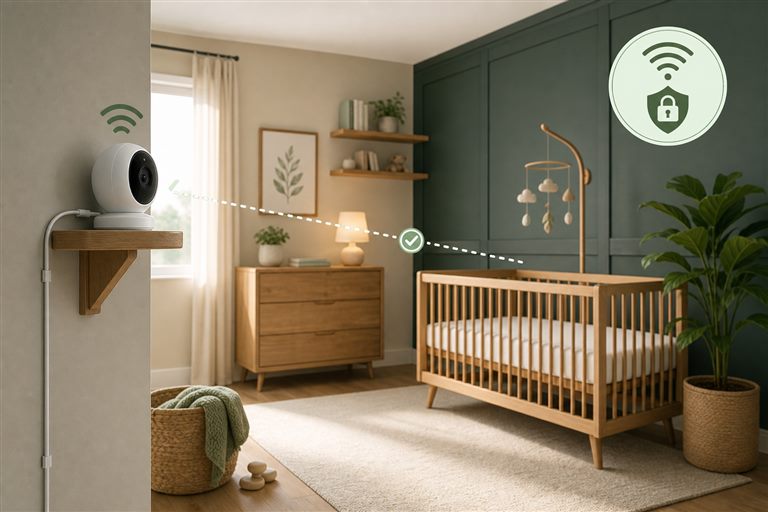
How to choose more safely without overcomplicating the decision

The AAP does not recommend against baby monitors. It does recommend against placing electronic devices immediately adjacent to the infant sleep surface, and against relying on monitors as a substitute for safe sleep practices. A 2024 study in a peer-reviewed journal found that poor device performance — including false alarms and connectivity drops — was associated with increased parental anxiety and sleep disruption for both parent and infant, which is the opposite of the intended effect.

The practical framework: if you will use a Wi-Fi monitor, treat its security as a continuous responsibility — not a one-time setup. Change the default password. Enable two-factor authentication. Keep firmware current. If you will use a DECT monitor, position it at a reasonable distance from the sleep surface and do not rely on it as a substitute for supervision or safe sleep practices. For a step-by-step framework covering all the criteria that matter most, read the guide on how to choose a safe baby monitor.

Ask these three questions before buying

Do I actually need remote viewing from outside the home, or would in-home monitoring be enough?

Am I willing to manage passwords, firmware updates, and app permissions over time?

Can I place the monitor at least 3 feet from the sleep surface in the room I will actually use?

The checklist removes guesswork. It maps your situation to the right features — before you spend.

Open the Baby Monitor Checklist →