Short outing
Diapers, wipes, changing surface, feeding needs, spare clothing, disposal bag, caregiver essentials and any medically necessary items.
Choose around the items you actually carry, then test access and comfort with the bag fully loaded.
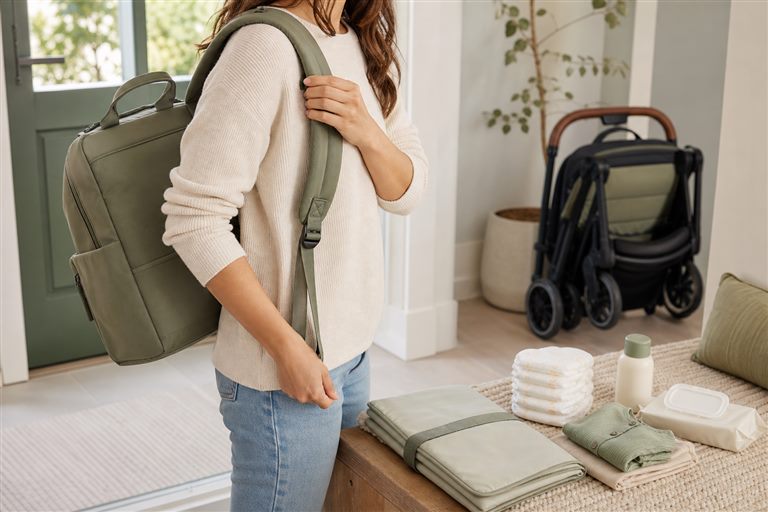
Choose a diaper bag by packing the items you genuinely use for a typical outing, then testing the bag at that weight. Look for enough usable space without excess bulk, a carry style that remains comfortable, wide and one-handed access, durable zippers, and a layout that keeps urgent items reachable. Check whether the lining, outer fabric and changing pad can be cleaned according to clear instructions. Treat “water-resistant,” “waterproof” and “wipe-clean” as different claims, and verify what part of the bag each describes. Bottle insulation may slow temperature change but does not establish safe storage time. If the bag includes stroller straps, follow the stroller manufacturer’s instructions because handlebar loading can affect stability. For travel, measure the packed bag and confirm current carrier rules before departure.
| Feature | Why it matters | What to verify | Trade-off |
|---|---|---|---|
| Usable capacity | Holds the routine load | Pack your real items | Extra space invites overpacking |
| Loaded comfort | Affects every outing | Padding, adjustment and balance | More structure can add weight |
| Opening and layout | Controls one-handed access | Zippers, visibility and pocket reach | Many pockets reduce flexible space |
| Cleanability | Spills reach seams and lining | Care label and removable parts | Coatings may need special care |
| Bottle storage | Helps keep bottles upright | Pocket size, closure, actual insulation claim | Insulation takes space |
| Travel fit | Matters in tight spaces | Packed dimensions and current carrier rules | Compact bags carry less |
Diapers, wipes, changing surface, feeding needs, spare clothing, disposal bag, caregiver essentials and any medically necessary items.
Add only the quantities the routine requires. Separate clean, feeding, wet and frequently reached items so a full unpack is unnecessary.
Capacity numbers do not show whether the opening, pocket shapes and base make the space usable. The smallest bag that fits the real routine is often easier to carry consistently.
Distributes weight across two shoulders and keeps hands free. Test strap spacing, adjustment and access while worn.
Can provide quick access and simpler visibility. A one-sided load may become uncomfortable on longer walks.
Adapts between routines. Check whether unused straps tuck away and whether extra clips create bulk.
Confirm the adjustment range and whether each caregiver can find essential items without reorganizing the bag.
Use your preferred carry style as the first filter, then verify loaded comfort, dimensions, closures, cleanability, stroller-use instructions and seller details for the exact bag.
Affiliate disclosure: Amazon links may earn Verify Baby Guide a commission at no additional cost to you. These are browse links; verify the exact product rather than assuming every result meets this guide's criteria.
Wipe-clean describes a cleaning method or surface. Water-resistant means some resistance to penetration under stated conditions. Waterproof is a stronger claim that still may not apply to zippers, seams or every compartment. Read the care label and identify exactly which component the claim covers. Inspect light-colored linings, corners and seams where leaks and residue are easier to miss.
Verify bottle diameter, height, pocket closure and whether the bag remains stable when bottles are loaded. Insulated pockets may slow warming or cooling, but performance depends on starting temperature, ambient conditions and time. Do not infer a safe feeding-storage period from the word “insulated”; follow current guidance for the milk or food being carried.
A loaded bag on a handle can change stroller stability. Do not assume included bag straps mean every stroller permits handlebar attachment. Use the stroller basket or manufacturer-approved attachment points, observe the exact stroller instructions, and remove the bag if steering, braking or stability changes. Use the baby-stroller buying guide to assess loading and routine fit, then verify the exact model with the Baby Stroller Safety Checklist.
Measure after packing and confirm current airline or carrier rules for personal items, liquids, feeding supplies and medical necessities. Choose closures that contain small items during screening, keep essential supplies accessible, and avoid packing critical items only in checked baggage.
Then use the Diaper Bag Checklist to verify the exact bag before buying.
Prioritize loaded comfort, usable capacity, one-handed access, cleanable materials, durable closures and a layout that matches your routine.
A backpack usually spreads weight and keeps hands free; a tote can provide faster access. A convertible may offer both but adds straps and hardware.
Choose the smallest bag that holds a realistic outing load without overpacking. Capacity needs vary by trip length, feeding routine, number of children and caregiver needs.
Follow the stroller manufacturer’s instructions and loading guidance. A bag on the handle can change stability, so use approved storage or attachments only as directed.
Insulation may slow temperature change but does not prove safe storage time. Follow current feeding and food-safety guidance and verify the bag’s specific claim.
Use the checklist for storage, zippers, straps, changing-pad fit, cleaning claims, support and seller legitimacy.
Open Diaper Bag Checklist →